
On August 30, 2026, President Claudia Sheinbaum submitted a bill to Congress that would amend the Foreign Investment Law and create a national-security review mechanism for foreign acquisitions in Mexico.
Background
The Foreign Investment Law, in force since 1993, sets the conditions under which non-Mexican investors may participate in Mexican companies and assets. It reserves certain activities to the State or to Mexican nationals, caps foreign participation in others, and requires prior approval from the National Foreign Investment Commission (the “CNIE”) when foreign investors seek to exceed a 49% interest in the activities listed in Articles 8 and 9, which include various activities related to transportation, education and legal services. Approval decisions have so far turned on economic criteria: employment, technology transfer, environmental compliance and competitiveness. The bill adds national security as an additional focal point and builds a dedicated procedure around it.
Key Changes
- Mandatory prior clearance: Foreign investors will need a favorable CNIE resolution before they can hold, directly or indirectly, (1) more than 49% of the capital stock of a Mexican company (2) that exceeds an asset threshold to be set by the CNIE and (3) operates in one of the five sectors listed below. The asset threshold is unknown and must be published within 180 calendar days of the bill taking effect.
- No deemed approval. If the CNIE does not act in time, the application is denied. The affirmative silence rule of Article 28, under which silence implies approval, will not apply to these filings.
- Security and intelligence agencies join the CNIE. The defense, navy and public security ministries would vote alongside the economic ministries that have historically made up the commission. The federal prosecutor’s office, the civilian intelligence agency, the tax authority and the financial intelligence unit would attend with voice but no vote, and no member may abstain.
- Higher fines. Proceeding with a covered transaction after a denial or without clearance, or breaching a mitigation condition, would result in a fine of roughly MXN 587,000 to MXN 23.5 million at the 2026 UMA (an index used for adjustment of fines) of MXN 117.31. The fine reaches the Mexican seller as well as the foreign investor.
Sectors covered by the Bill
| Category | Scope as drafted |
| I. Strategic infrastructure, physical or virtual | Infrastructure linked to energy; transportation; health; communications; mining; data processing or data storage; digital systems; aerospace; defense; sensitive facilities. Also land and buildings indispensable to the use of any of that infrastructure. |
| II. Critical technologies and dual-use products | Artificial intelligence; robotics; semiconductors; cybersecurity; aerospace technologies; defense technologies; energy storage; quantum; nuclear; nanotechnologies; biotechnologies. |
| III. Supply of fundamental inputs | In particular energy or raw materials, and inputs implicating food security. |
| IV. Sensitive information | Access to sensitive information, in particular personal data, or the ability to control that information. No volume qualifier appears in the text. |
| V. Catch-all | Any other analogous activity or economic sector of a similar nature designated by the CNIE by general resolution. |
The Procedure
A filing is made jointly by the Mexican company and the foreign investor. The CNIE has 60 business days to resolve, extendable once by up to 30 business days, and the clock stops once while the parties answer a request for information.
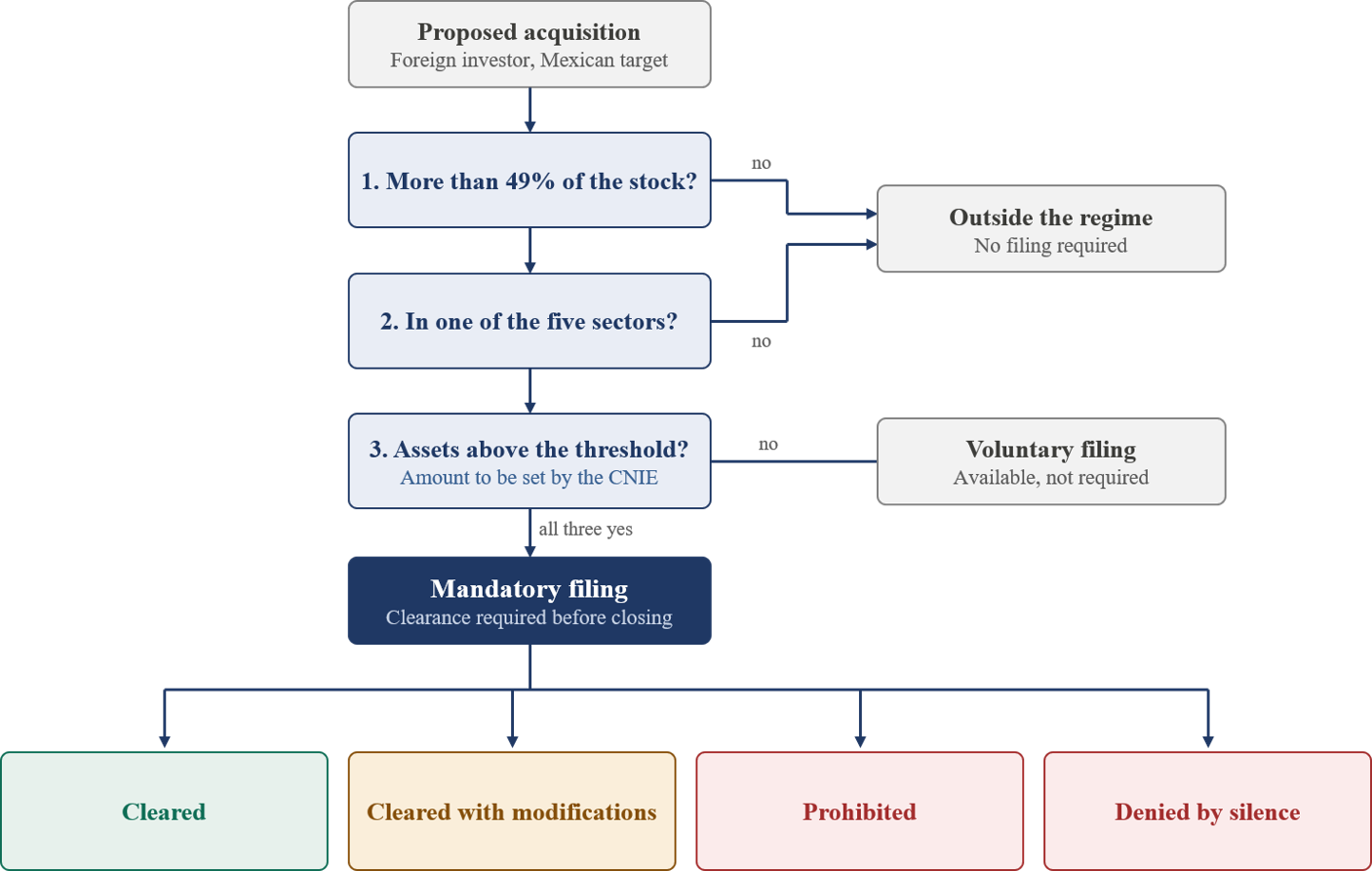
Although the new national security review requirements would not be retroactive, follow-on transactions are a different matter. Increasing an existing stake, selling a foreign-controlled Mexican company to another foreign investor, bolt-on acquisitions by a foreign-controlled Mexican platform, and upstream reorganizations or changes of control at parent level can all fall within the regime.
Practical Implications
- For cross-border M&A and private equity transactions, the new national security review adds a diligence layer and new closing conditions. The diligence record will need to include asset valuations, a description of the data the target holds, and any government or critical infrastructure customers.
- Foreign investors should map existing and planned Mexican holdings against the five categories, including businesses that are only incidentally data-related or infrastructure-related.
- Complying with this new national security review will require prior analysis and negotiation of appropriate deal terms – it cannot be treated as a mere post-signing formality.
- Prepare CFIUS-style readiness file, including ultimate beneficial ownership, source of funds, sanctions and AML profiling and Mexican tax structure.
- USMCA investors receive no exemption and there is no distinction based on state ownership or country of origin. Although application in practice will matter under the USMCA and Mexico’s investment treaties, investors should not assume treaty protections will exempt them from filing.
- Deals currently under consideration should not be delayed based on concern about the bill alone; it remains subject to congressional consideration, will not be retroactive and will likely take time to become effective.
CFIUS similarities (and differences)
An analogy with the Committee on Foreign Investment in the United States (CFIUS) process is commercially useful, as the new national security review would work as an interagency, security-driven review of inbound investment and would be capable of blocking transactions. The differences are just as instructive. Jurisdiction turns on a bright line of more than 49% of capital stock, so the proposal does not expressly reach minority investments however extensive the investor’s rights. Percentage ownership is an imperfect proxy for influence, and the U.S. framework, which reaches any acquisition of control and certain non-controlling investments in certain critical businesses, does not rely on percentage ownership in such an absolute manner. Also, the text does not authorize the Commission to review a transaction the parties did not notify, nor does it articulate a post-closing divestiture regime of the kind familiar from the U.S. and U.K., so post-closing enforcement rests on fines. The asset threshold applies even in the most sensitive sectors, and the silence-as-denial rule has no CFIUS parallel.
Key Takeaways
Mexico has had the power to block foreign acquisitions since 1993, but now it is proposing to institutionalize it. This is familiar ground for US deal teams. US deal teams already negotiate around antitrust and investment security review (CFIUS) conditions. Regulatory conditionality is a well-developed feature of US law-governed acquisition agreements, and US courts have a deep body of caselaw on efforts standards, failure of closing conditions and the remedies that follow, which will inform strategies for managing analogous challenges in Mexican transactions.